
Advanced Urologic Surgery · Abu Dhabi
Laparoscopic Radical Prostatectomy for Prostate Cancer
Experience Beyond the Technology
500+Laparoscopic radical prostatectomies
74%Potency at 12 months
In previously potent men with bilateral nerve-sparing, with or without PDE5 inhibitors
More than 500 laparoscopic radical prostatectomies with a focus on cancer control, urinary continence and preservation of sexual function when oncologically appropriate.
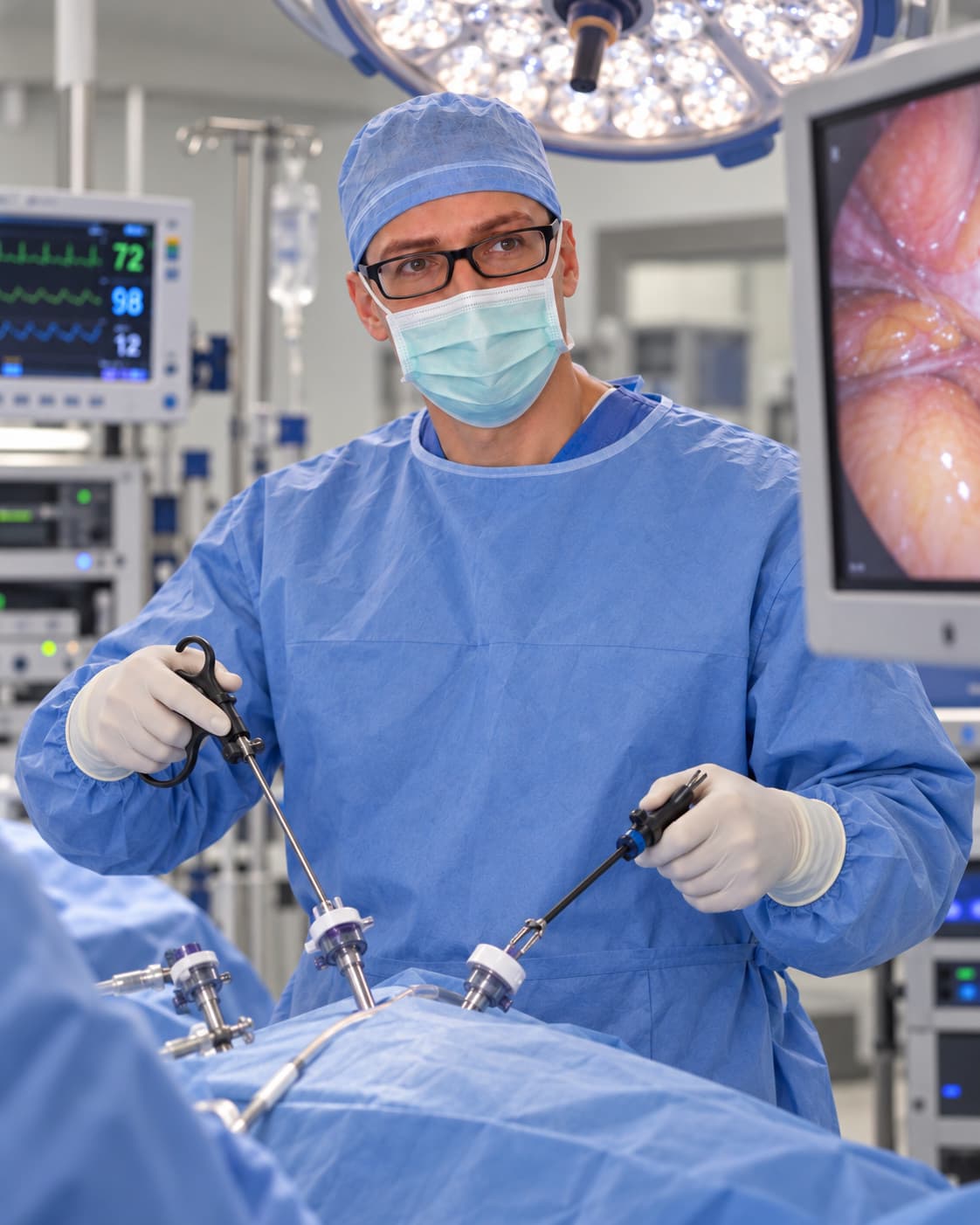
Dr. Molina performs laparoscopic, not robotic, radical prostatectomy — this page explains the difference between the two approaches, and why the surgical platform is only one part of the outcome.
Dr. Alejandro Molina
Consultant Urologist & Andrologist
Understanding the procedure
What Radical Prostatectomy Is
Radical prostatectomy is the surgical removal of the entire prostate gland, along with the seminal vesicles, as a treatment for prostate cancer. The goal is to remove the cancer completely while, where oncologically appropriate, preserving the structures responsible for urinary control and erectile function.
Candidacy
Who May Be a Candidate
Radical prostatectomy is generally considered for men with prostate cancer confined to the gland (localized disease), and sometimes for select cases of locally advanced disease, depending on overall health, life expectancy and personal preference relative to other treatment options such as radiotherapy or active surveillance. This is not a recommendation that surgery is the right choice for every man with prostate cancer — candidacy is assessed individually, based on your specific diagnosis, imaging, biopsy pathology and overall health, and discussed alongside the alternatives relevant to your case.
The approach
The Laparoscopic Approach
Laparoscopic radical prostatectomy is performed through several small incisions in the abdomen, using a camera (laparoscope) and long, specialized instruments the surgeon operates directly by hand, rather than through a single large open incision. This minimally invasive approach is associated with less blood loss, smaller scars and generally faster early recovery than open surgery, while allowing the same surgical goals — complete cancer removal and, where appropriate, nerve preservation — to be pursued.
A transparent comparison
Laparoscopic vs Robotic Radical Prostatectomy
Both laparoscopic and robot-assisted radical prostatectomy are minimally invasive approaches — the prostate is removed through several small incisions rather than one large open incision, using a camera and instruments rather than the surgeon’s hands directly inside the body.
Robotic surgery uses a robotic surgical platform that the surgeon controls in real time from a console a few feet away, translating the surgeon’s hand movements into the instruments’ movements inside the patient. The robot does not operate autonomously and does not make surgical decisions independently — every movement is the surgeon’s.
Laparoscopy and robotics differ technically — in instrumentation, visualization and how directly the surgeon manipulates the instruments — but the surgical platform alone does not determine the outcome. The surgical platform is only one part of the outcome: surgeon experience, technique, patient selection and surgical volume also play a major role. Robotic technology can offer technical advantages, but published outcomes vary substantially between surgeons and centres, and high-volume laparoscopic series can achieve oncological and functional outcomes within the range reported by contemporary high-volume robotic programs.
Dr. Molina performs laparoscopic, not robotic, radical prostatectomy.
Why it matters
Why Surgeon Experience Matters
Radical prostatectomy — by any minimally invasive platform — is a technically demanding operation in which a number of specific factors, developed over a surgeon's career, materially affect both cancer control and functional recovery.
Learning curve
Published data on laparoscopic radical prostatectomy consistently show that outcomes — particularly positive surgical margins — improve substantially over a surgeon's early case volume, and continue to improve well beyond the first 100–200 cases before reaching a plateau.
Surgical volume
Higher cumulative case volume is associated with better oncologic and functional outcomes across the published literature, independent of which minimally invasive platform is used.
Apical dissection
The prostate's apex is anatomically the most common site of a positive surgical margin. Precise dissection at this level, balancing complete cancer removal against preservation of the urinary sphincter, is one of the technically demanding steps in the operation.
Bladder-neck management
How the bladder neck is handled and reconstructed affects both early continence recovery and the technical quality of the reconnection to the urethra.
Neurovascular bundle preservation
Where oncologically appropriate, preserving the neurovascular bundles adjacent to the prostate is central to erectile function recovery — a judgment made individually, not applied uniformly to every patient.
Vesicourethral anastomosis
The reconnection between bladder and urethra needs to be precise and watertight — its quality affects catheter duration and early continence.
Oncological decision-making
Intraoperative decisions — how wide a margin to take in a given location, whether to modify or abandon nerve-sparing based on what is found — are judgment calls informed by experience, not steps that can be fully standardized in advance.
Patient selection
Recognizing which patients are, and are not, good candidates for a nerve-sparing approach — and setting realistic expectations accordingly — is itself a skill that develops with experience.
The surgical platform is only one part of the outcome. Surgeon experience, technique, patient selection and surgical volume also play a major role.
The evidence
Outcomes Depend on More Than the Platform
Published benchmark ranges — not a randomized comparison. Published series are not directly interchangeable: results vary according to patient selection, tumour stage, baseline function, nerve-sparing eligibility, outcome definitions, surgeon volume and follow-up. These figures are provided as context, not as a direct comparative trial.
Dr. Alejandro Molina
Personal laparoscopic radical prostatectomy series
- 12-month strict continence
- 89%
- 12-month social continence
- 93%
- 12-month potency
- 74%
- Global positive surgical margins
- 16%
- pT2 positive surgical margins
- 6%
- pT3 positive surgical margins
- 18%
- Major complications
- 2.5%
0 pads/day
0–1 safety pad/day
Previously potent patients, bilateral nerve-sparing, erections sufficient for penetration with or without PDE5 inhibitor therapy
Clavien-Dindo grade ≥III
LRP — learning curve
Lower-volume published series
- 12-month strict continence
- ~65–80%
- 12-month social continence
- Not consistently reported using the same 0–1 safety-pad definition in the published literature identified.
- 12-month potency
- ~30–50% (estimated from the general learning-curve literature; not directly reported at this definition in a dedicated study)
- Global positive surgical margins
- 20–30%
- pT2 positive surgical margins
- ~18–30%
- pT3 positive surgical margins
- ~30–45%
- Major complications
- ~5–10%
LRP — high-volume
Expert published series
- 12-month strict continence
- 85–94%
- 12-month social continence
- Not consistently reported using the same 0–1 safety-pad definition in the published literature identified.
- 12-month potency
- 65–76%
- Global positive surgical margins
- ~8–15%
- pT2 positive surgical margins
- ~10–15%
- pT3 positive surgical margins
- ~28–35%
- Major complications
- ~3–6%
RARP — contemporary
High-volume published series
- 12-month strict continence
- 85–95%
- 12-month social continence
- Not consistently reported using the same 0–1 safety-pad definition in the published literature identified.
- 12-month potency
- 55–85%
- Global positive surgical margins
- 10–20%
- pT2 positive surgical margins
- ~7–10%
- pT3 positive surgical margins
- ~30–40%
- Major complications
- ~3–5%
Dr. Molina’s outcomes sit within the range reported by contemporary high-volume laparoscopic and robotic series. Where individual figures — such as pT2 and pT3 margin rates — are numerically favourable compared with published ranges, this is best described as consistent with the favourable end of published ranges, not as evidence of general superiority over any specific approach.
Dr. Molina's series
Dr. Molina's Laparoscopic Radical Prostatectomy Series
The following outcomes are Dr. Molina’s own laparoscopic radical prostatectomy series — practice-series data supplied by the treating surgeon, not an independently audited registry or a randomized comparative trial. Published benchmark ranges are shown separately, above, as context rather than a head-to-head comparison.
500+
Procedures performed
Laparoscopic radical prostatectomies, personal series.
89%
Strict continence
12 months, 0 pads/day.
93%
Social continence
12 months, 0–1 safety pad/day.
74%
Potency
12 months, among previously potent patients, bilateral nerve-sparing, erections sufficient for penetration with or without PDE5 inhibitor therapy.
16%
Global positive margins
global positive surgical margin rate.
6%
pT2 positive margins
pT2 positive surgical margin rate.
18%
pT3 positive margins
pT3 positive surgical margin rate.
2.5%
Major complications
Clavien-Dindo grade ≥III.
After surgery
Cancer Control
After surgery, the removed prostate and any excised tissue is examined by a pathologist, who reports the pathological stage (how far the cancer extends within or beyond the prostate), the tumour’s grade, and whether a positive surgical margin is present at any point around the specimen’s outer edge.
A positive surgical margin is a pathological finding, not a diagnosis of recurrence — it means cancer cells were found at the cut edge of the removed tissue, which can be associated with a higher chance of biochemical recurrence over time, but does not by itself mean the cancer has come back or will come back.
Follow-up after surgery centres on PSA (prostate-specific antigen) monitoring. Because the prostate has been removed, PSA should fall to an undetectable level; a confirmed rise from that point is what defines biochemical recurrence — a laboratory finding that may or may not require further treatment, discussed individually if it occurs.
Recovery
Urinary Continence
Continence is generally reported in two ways: a strict definition of zero pads used per day, and a social continence definition allowing at most one safety pad per day for reassurance rather than genuine leakage. Both are legitimate ways of describing recovery, and both are reported separately here so the difference is clear rather than blended into one number.
Continence typically recovers gradually over the weeks and months following catheter removal, rather than immediately — early leakage in the first weeks is expected and does not predict the eventual result. In Dr. Molina’s series, 89% of patients are using 0 pads/day at 12 months, and 93% meet the 0–1 safety pad/day social-continence standard by the same timepoint.
Sexual function
Nerve-Sparing and Erectile Function
Oncological safety comes first. Nerve-sparing — preserving the neurovascular bundles that run alongside the prostate and are responsible for erectile function — is only appropriate when it does not compromise complete removal of the cancer, based on tumour location and characteristics.
Not every patient is a candidate for nerve-sparing, and among those who are, some are suitable for bilateral (both-sided) preservation while others are only suitable for unilateral (one-sided) preservation, or none. Baseline erectile function before surgery, age, and the specific anatomy and pathology found all factor into this individualized decision.
In Dr. Molina’s series, 74% of previously potent patients, bilateral nerve-sparing, erections sufficient for penetration with or without PDE5 inhibitor therapy, at 12 months. This figure applies specifically to that group — previously potent patients who underwent bilateral nerve-sparing — and does not generalize to patients outside that definition.
For men who experience persistent erectile dysfunction after prostate cancer treatment, this is assessed and managed the same way as erectile dysfunction from any other cause, including rehabilitation and medication where appropriate. Where erectile function does not recover and is significantly affecting quality of life, and other treatments have not been effective, penile implant surgery is one option discussed at that stage.
Safety
Complications and Safety
As with any major surgery, radical prostatectomy carries risk of complications, most of which are minor and managed straightforwardly. Major complications are classified using the Clavien-Dindo system, where grade ≥III specifically means a complication requiring surgical, endoscopic or radiological intervention under anaesthesia, or a life-threatening or fatal event — a meaningfully higher bar than any complication at all.
In Dr. Molina’s series, the rate of major complications (Clavien-Dindo grade ≥III) is 2.5%. Specific risks relevant to your individual case are discussed in detail at consultation, before any decision to proceed.
What to expect
Recovery
A urinary catheter is typically kept in place for a short period after surgery to allow the reconnection between bladder and urethra to heal, and most patients spend a small number of days in hospital. Light activity generally resumes within a few weeks, with fuller activity over the following weeks to months. PSA is checked at intervals during follow-up to confirm it falls to an undetectable level and stays there, and continence and erectile function — where relevant — continue to recover gradually over the following months. Individual recovery varies, and specific expectations for your situation are discussed as part of your treatment plan.
FAQs